knife of bone or ivory to cut large blocks of hard-packed snow. The
builder then arranged the blocks in a circle about 10 to 15 feet (3–4.6
m) in diameter. He trimmed the tops of the blocks to slope inward.
Then he stacked a new layer of blocks on top of the first. He kept
stacking snow blocks until he had created a perfect dome shape,
about 10 to 12 feet (3–3.7 m) high. A small hole was left at the top
to allow smoke to escape. Sometimes, clear ice or animal intestines
were used to create windows. A layer of snow was packed around
the outside of the igloo to provide insulation. Inside, a blubber lamp
was used to melt the interior walls. The walls were then allowed to
quickly refreeze into a smooth glaze of ice that blocked the wind.
Low benches and sleeping platforms made with hard-packed snow
were covered with twigs and furs to provide warmth.
To move from place to place in the Arctic, the Inuit relied on
boats and sleds. They built two kinds of boats. The one- or two-
person kayak had a frame of driftwood or whalebone. Stretched
skins from seals or other animals covered the frame. The larger
umiak was also made of driftwood or whalebone covered with
sealskin, but it had a flat bottom for greater stability. At 15 to 50
feet (4.6–15.2 m) long and 5 feet (1.5 m) wide, an umiak could hold
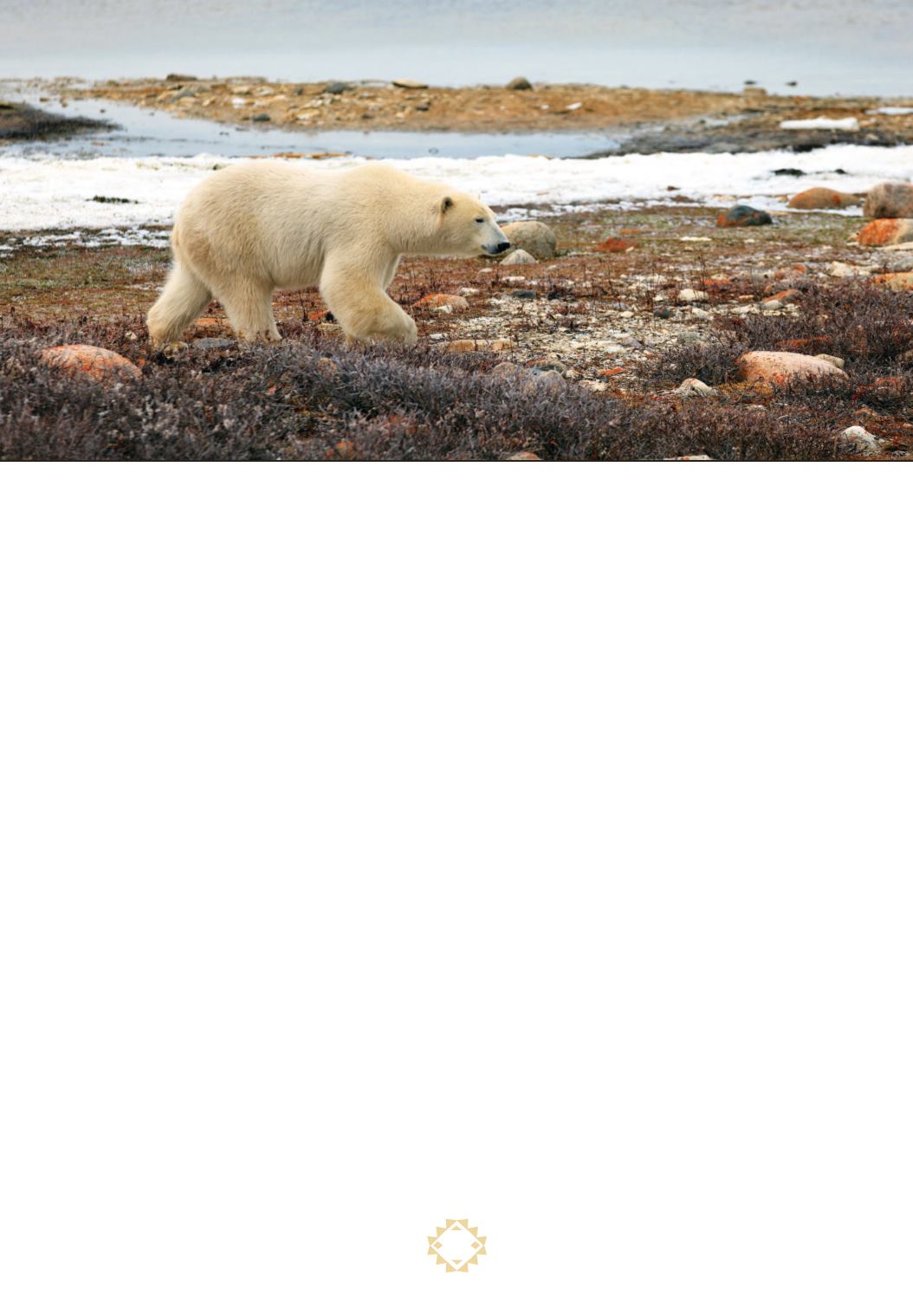
Despite the polar
bear’s endangered
status, Canadian
Inuit are allowed
to hunt a limited
number each year.
12


